AI Is Not a Tool Anymore. It Is a Teammate. Here Is Why That Changes Everything.

There is a pattern playing out across boardrooms, founder meetings, and executive offsites right now. Someone brings up AI, the room gets excited, and within weeks the company has plugged it into their operations. A few months later, the honest debrief sounds something like: "We spent more time correcting the output than we saved using it." The technology was not the problem. The approach was.
AI has crossed a threshold. What started as a productivity tool, something to speed up a task or generate a quick draft, has evolved into something fundamentally different. It is now a teammate. And that distinction is not semantic. It changes everything about how it should be deployed, trained, and trusted inside a growing business.
For Series A and B founders pushing toward the next inflection point, for SMB leaders who have crossed the ten-million-dollar mark and are staring down a growth plateau, and for the board members and investors who are asking hard questions about operational readiness, this is the conversation that needs to happen.
From Tool to Teammate: A Distinction That Demands a Different Playbook
When AI first arrived in its current form, the instinct was to treat it like a sophisticated piece of software. You open it, type a prompt, get an output, move on. That is how most organizations still use it today, and that is precisely why most organizations are not getting the results they expected.
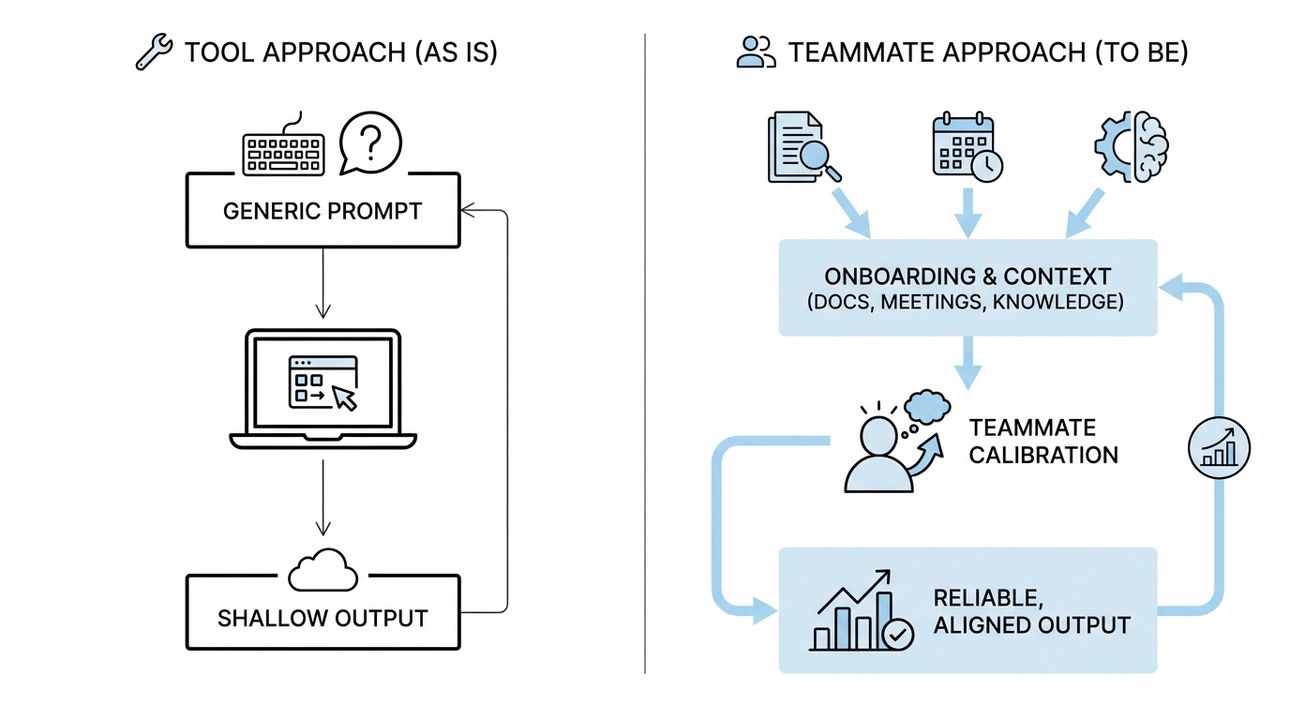
Think about what happens when a new hire joins a high-performing team. They do not walk in on day one and immediately operate at full capacity. There is onboarding, context-setting, and a period of calibration where they learn how the organization thinks, communicates, and delivers. The team invests time upfront so the return compounds over time.
AI requires the same investment. Dropping a generic prompt into a tool and expecting it to understand the nuance of a business, its tone, its priorities, and its processes is the operational equivalent of handing a new employee a laptop and walking away. The output will reflect the input. And if the input is shallow, the output will be too.
The businesses that are genuinely unlocking value from AI are the ones treating it like a team member they have deliberately onboarded. That means giving it context, feeding it relevant documents, recording and organizing meetings so it has institutional knowledge to draw from, and defining clearly how it should operate within specific workflows. The more intentional the setup, the more reliable and aligned the output becomes. That is not a technology insight. That is an operations insight.
The Data Problem Nobody Wants to Talk About
Here is where many organizations quietly run into serious trouble. AI is extraordinarily capable of pulling from vast datasets and presenting information with confidence. What it cannot do, by default, is validate whether that information is accurate, contextually appropriate, or free from bias.
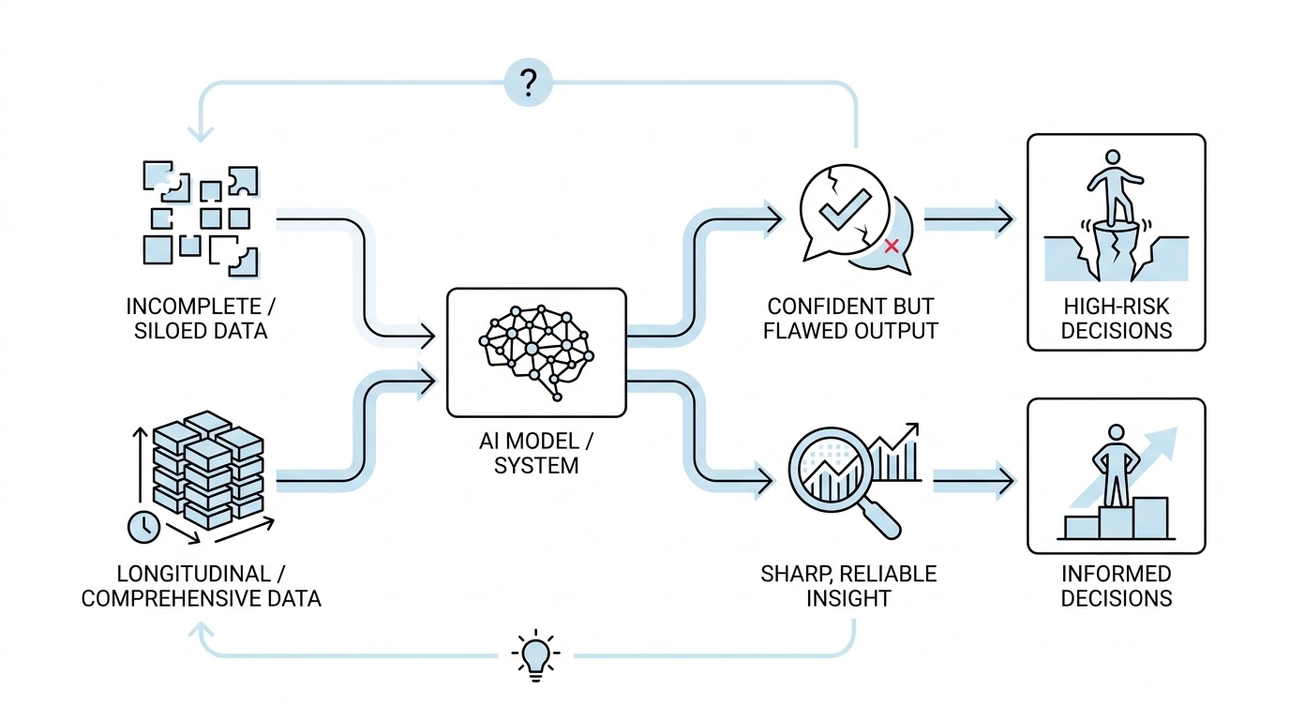
This creates a risk that scales with the ambition of the use case. For a Series B company preparing to enter a new market, or an SMB leader making resource allocation decisions, the cost of acting on flawed analysis is not trivial. And yet, the data integrity question is rarely the first thing asked when a business decides to bring AI into its operations.
The quality of AI output is a direct reflection of the quality of data going in. Clean, well-organized, contextually rich data produces sharp, reliable analysis. Incomplete, siloed, or cherry-picked data produces something far more dangerous: confident-sounding conclusions built on a shaky foundation.
There is also a subtler issue. When data is selectively fed into an AI system, even with good intentions, it creates bias in the output. The system learns to see the world the way the data was curated, not the way the world actually is. For business decisions that depend on genuine insight, that is a significant liability.
The better approach is to give AI longitudinal and comprehensive data, information that spans time, function, and perspective, rather than narrowing its input to what already confirms existing assumptions. That breadth is what allows AI to surface genuinely useful patterns, rather than echoing back what the business already believes.
Where AI Actually Earns Its Place on the Team
Once the foundation is right, the question becomes: where does AI create the most leverage? The answer, in operational terms, is clear. AI excels at the work that is necessary but does not require human creativity, judgment, or relationship-building.
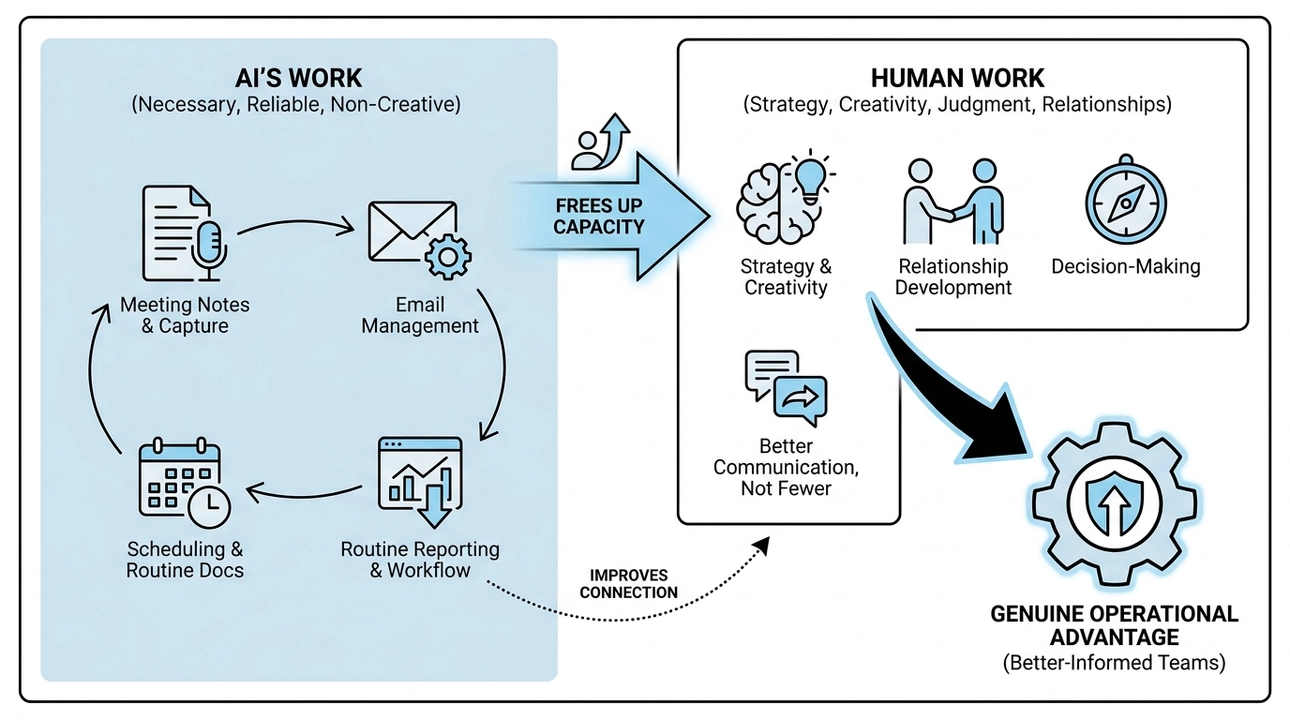
Meeting notes are the obvious example. When meetings are properly recorded and routed through a well-configured AI workflow, the right people receive the right notes, action items are captured, and nothing falls through the cracks. That is not a small efficiency gain. In a scaling business, communication breakdown is one of the most common and costly operational failures.
The same logic applies to email management, routine reporting, scheduling, and workflow documentation. These are not glamorous tasks, but they consume enormous amounts of time across teams at every level. When AI handles them reliably, the humans in the room can focus on what actually moves the business forward: strategy, creativity, relationship development, and decision-making.
This is the lens through which AI adoption should be evaluated inside any scaling organization. Not "how do we use AI to do more?" but "how do we use AI to free up our people to do better?" That reframe matters, because the organizations chasing volume from AI often end up with faster noise. The ones chasing quality end up with a genuine operational advantage.
One more point worth sitting with: AI should be used to improve communication between people, not to reduce it. As AI agents and connectors become more sophisticated, the temptation will grow to automate entire communication chains. That is a path toward disconnection disguised as efficiency. The goal is better-informed teams, not fewer conversations.
What Gets Built Lasts
There is a broader lesson underneath all of this. Scaling a business, whether from Series A to B or from ten million to fifty million, is fundamentally an operations challenge. The businesses that break through plateaus are the ones that have built systems capable of carrying the weight of growth.
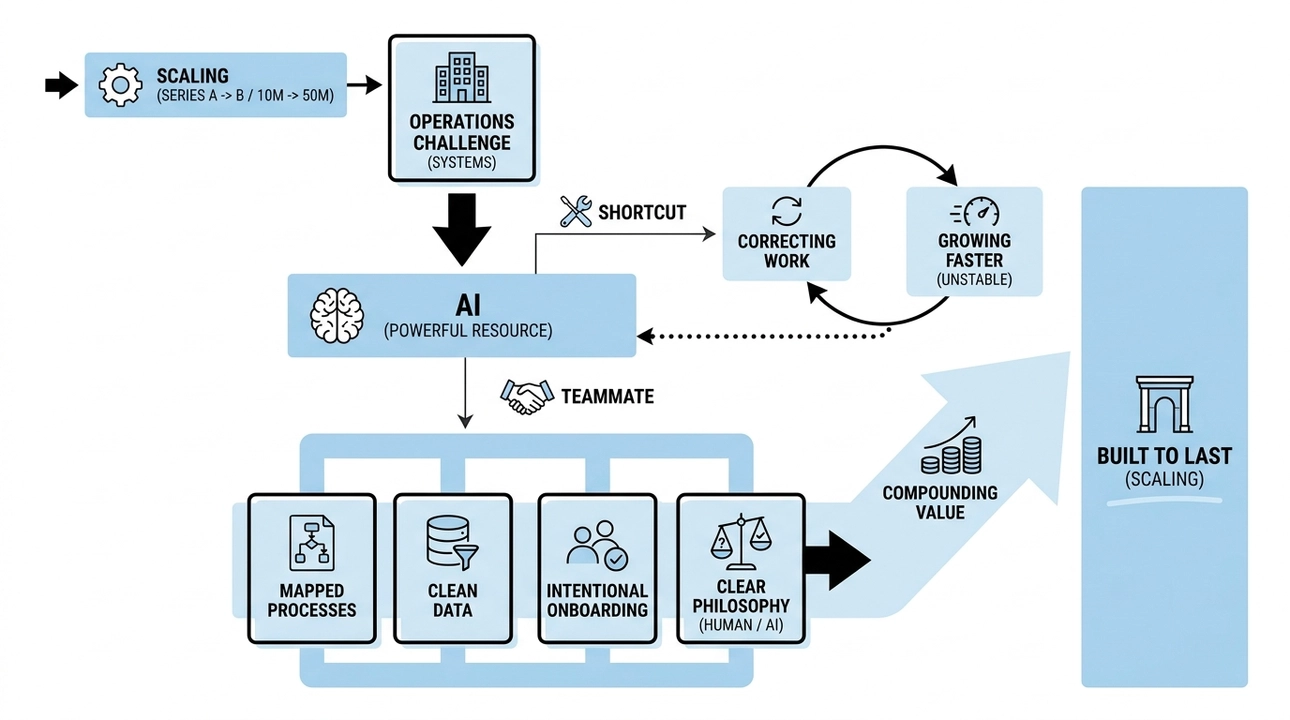
AI is now one of the most powerful resources available to help carry that weight. But like any powerful resource, its value is determined entirely by the infrastructure around it. Mapped processes, clean data, intentional onboarding, and a clear philosophy about where human judgment ends and AI support begins, these are not optional prerequisites. They are the foundation.
The organizations that treat AI as a shortcut will keep correcting its work. The ones that treat it as a teammate worth investing in will build something that compounds.
That is the difference between scaling and just growing faster.