The Leader Is Not the Plan: What Actually Earns Credibility When Everything Goes Sideways

There is a moment on every team, in every scaling business, when people stop looking at the plan and start looking at a person. It happens fast, usually when something breaks. And most leaders either miss it entirely or mistake it for a compliment.
It is neither. It is a signal.
The Process Is Muscle Memory. The Leader Is the Circuit Breaker.
Think about what happens when driving becomes automatic. Eyes on the road, hands on the wheel, breath steady. The brain is not consciously running every micro-decision. The body just does it. That is what a well-built process does for a team. It runs in the background so that everyone can keep functioning without burning out the person at the top.


That is the whole point of operational frameworks. Not bureaucracy. Not rigidity. Muscle memory. Repeatable actions, tracked over time, improved through data. What time of day does the team perform best? Where are the friction points? What needs to change? The process holds all of that so the team does not have to carry it in their heads.
But muscle memory has a limit. The moment something genuinely breaks, something outside the range of what the process was designed to handle, the body snaps to attention. The brain takes over. And on a team, that means people turn to a person.
That person is the circuit breaker. Not a replacement for the process. Not someone who swoops in and takes over forever. Someone who absorbs the shock, diagnoses the fault, communicates clearly, and helps the team find the path back to functioning. And then, critically, hands it back to the process so the improvements can be built in.
If a team is constantly bypassing the plan to follow a person, that is not leadership. That is a dependency, and it will cap how far the business can scale. The goal is a process strong enough to run on its own, with a leader trusted enough to intervene when it cannot.
Credibility Is Not a Title. It Is a Balance Sheet.
Here is where it gets interesting. For the circuit breaker to actually work, the team has to trust the person holding it. And that trust is not granted with a promotion or a title on a business card. It is earned, slowly, through something much harder to manufacture.
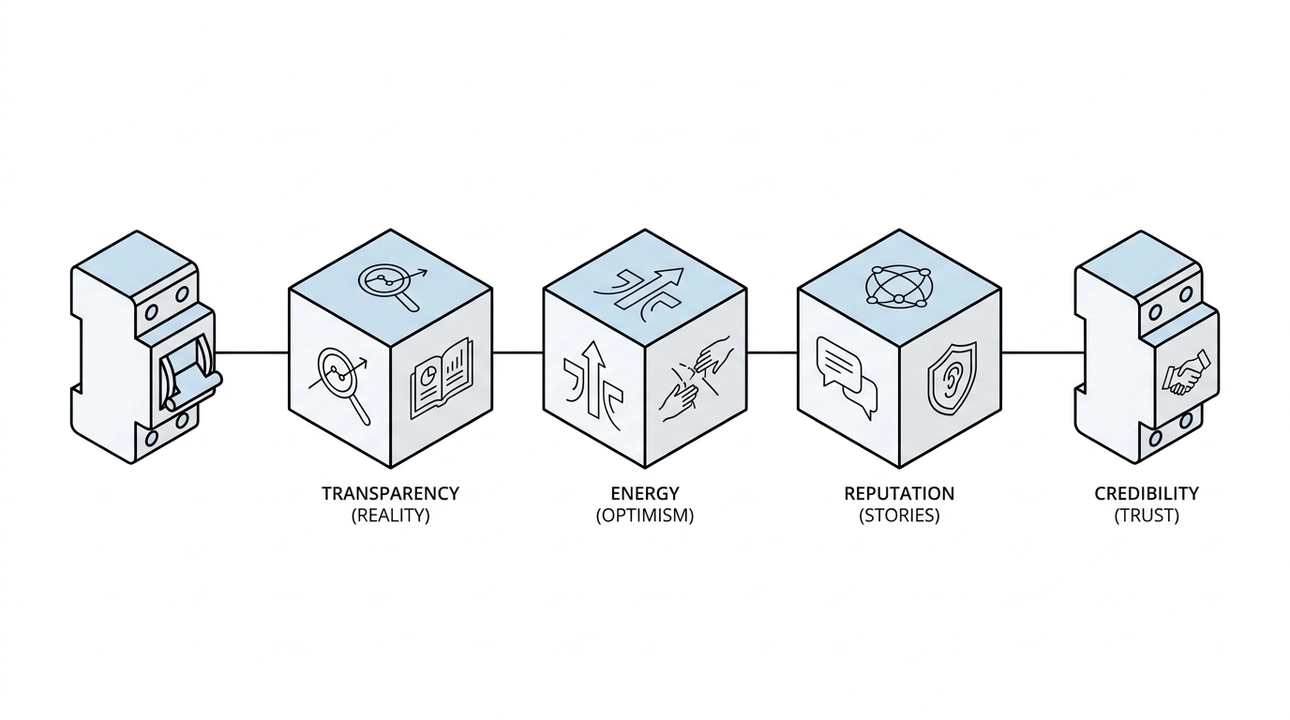

Credibility has layers, and none of them come from a resume.
The first layer is transparency about reality. Not the polished version of events, not the all-hands-meeting narrative, but the actual picture. Sharing the right amount of data. Not hiding what is going sideways. Being honest about what is not yet known. That honesty, especially when the news is bad, is what signals to a team that the person at the front is not going to manage them, they are going to level with them.
But transparency without optimism is just pessimism with good communication skills. The second layer is energy. The conviction that this is solvable, that the team will get through it, and the willingness to ask: what do you need? How can the path be cleared? What does getting through this actually look like together? That combination, honesty about the problem plus genuine belief in the solution, is what keeps people moving instead of freezing.
The third layer is the one that takes the longest to build and the least amount of control over: reputation. What people say about a leader in rooms they are not in. The way a team member describes how they were treated when things were hard. Whether someone felt heard, protected, and respected during a difficult moment. These are the stories that travel through a network and build, or quietly dismantle, credibility from the outside in.
None of this is abstract. In a small company, credibility gets built in the simplest moments. Whether the walk-in feels different from what the words promised. Whether a complaint was actually listened to. Whether something said on Monday was still true on Friday. Whether someone was thrown under the bus when the outcome was bad, or whether the leader stood with the team and said, we tried, we learned, we go again.
The Micro Moments Are the Method
The mistake most leaders make is thinking credibility is built in the big speeches or the bold decisions. It is not. It is built in the micro moments, the small, unremarkable, easily-forgotten interactions that pile up over time and form a pattern.

How a conflict gets handled when no one senior is watching. Whether a confidential conversation actually stays confidential. How the response to failure lands, not the polished version of it in a post-mortem, but the raw reaction in the moment. Whether vulnerability is allowed in the room, starting with the leader's own.
Credibility, at its core, is the accumulation of evidence that a person does what they say, treats people the way they would want to be treated, and keeps trying in a consistent direction even when it is hard. Nobody needs perfection. Teams are remarkably forgiving of mistakes. What they are not forgiving of is inconsistency. Nothing drains trust faster than a leader who is only as good as the last win.
Here is the test worth applying: in the rooms where the name comes up when it is not there, what is the story being told? Is it the story of someone who showed up when it was messy, who was straight about what they did not know, who fought for the team and then let the process carry it forward? Or is it a story of someone who looked great in the good moments and disappeared in the hard ones?
That story, the one told without the leader present, is the real measure of credibility.
The Process Scales. The Reputation Leads.
The businesses that actually scale are the ones where these two things coexist. A process strong enough to run without constant intervention, and a leader credible enough to step in when it cannot. One without the other creates either a machine with no soul or a personality cult with no infrastructure.

The circuit breaker is not the star of the show. The muscle memory is. But when things go wrong, and they will, the team needs to know exactly who to call, and why calling that person is going to make things better, not just louder.
Build the process so the team can breathe. Build the credibility so they know who to trust when they cannot. Toodles.